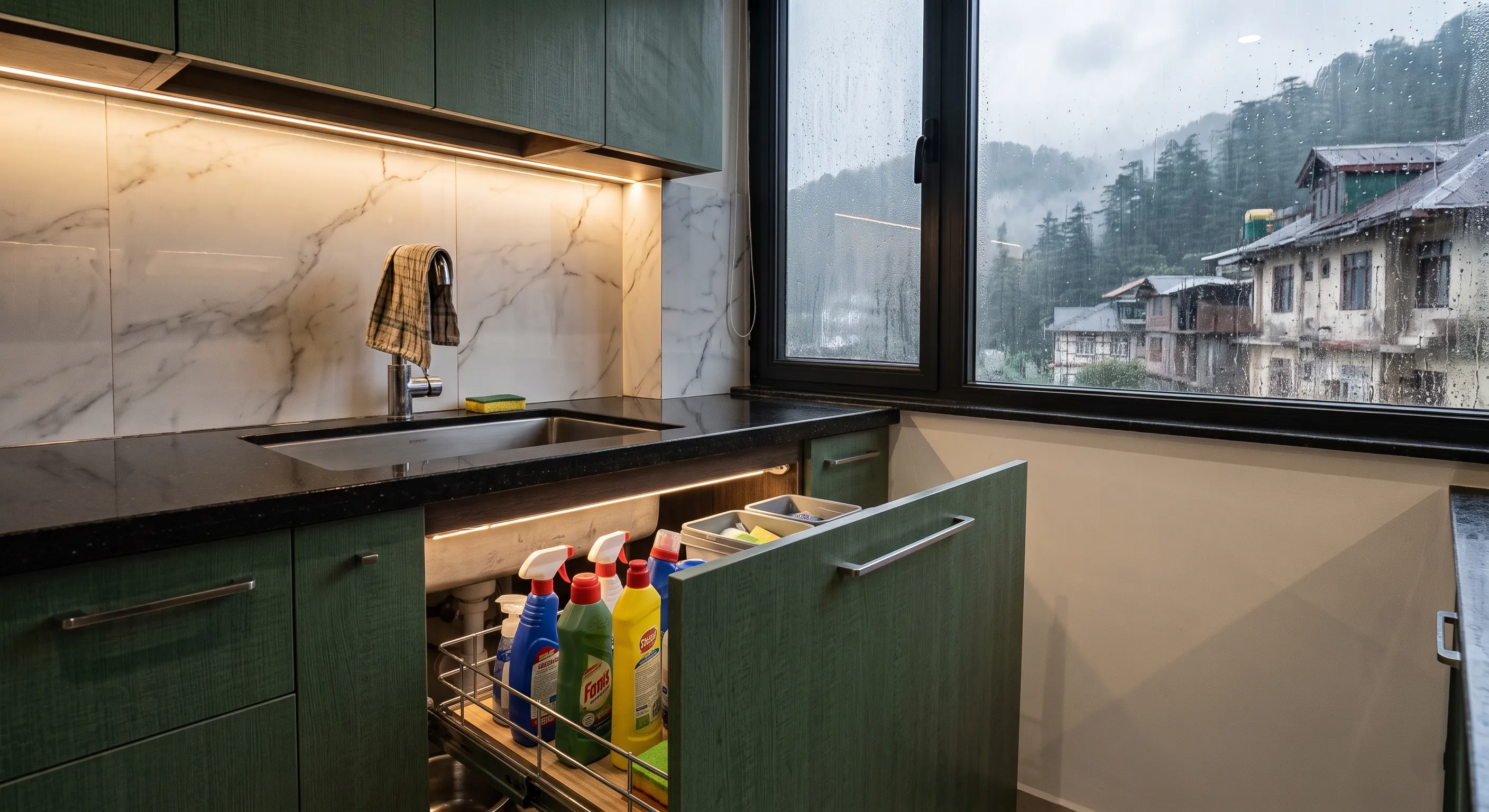
Building a Kitchen That Survive's Shimla's Himalayan Monsoon
As monsoon clouds enter the hills of Shimla, they bring cool weather, unbelievable views and months worth of humidity. While this climate creates the beauty the region is also exposed to one of the biggest weaknesses inside modern homes: poorly selected kitchen materials. Constant moisture slowly penetrates low-quality boards, weak adhesives and unprotected hardware, causing damage that often remains hidden.
Unlike homes in dry regions, kitchens across Shimla experience 2 separate sources of moisture every day. I. Cooking generates continuous steam, II. while the surrounding air remains humid for 4-5 months.
The most expensive mistake homeowners make is focusing only on visible finishes such as laminates, and handles while overlooking the interior base hidden beneath them. The strength of a kitchen depends on its foundation. Choosing certified moisture- resistant boards, premium edge sealing systems and corrosion-resistant hardware is better investment for the long term.
Whether you are building a new home, renovating an existing kitchen, understanding how different materials perform in Shimla's unique climate will help you avoid premature failures and reduce long-term maintenance costs. This guide explains the engineering principles behind a moisture-proof kitchen and highlights the materials that deliver reliable performance.
Shimla Monsoon Checklist
Before approving a kitchen design or purchasing materials, evaluate every major component using this checklist.
| Kitchen Area | Primary Risk | Recommended Solution |
|---|---|---|
| Cabinet Carcass (Under Sink) | Pipe condensation, standing moisture and structural swelling | BWP Marine Plywood or Premium HDHMR Boards |
| Countertops & Splashbacks | Water entering through joints and exposed edges | Granite or Large-Format Vitrified Slabs with Epoxy Grout |
| Cabinet Shutters | Surface bubbling and laminate separation | Marine-Grade Laminates bonded with PUR Adhesives |
| Cabinet Edges | Moisture entering exposed board edges | 2mm PVC Edge Banding with PUR Hot-Melt Bonding |
| Hinges & Drawer Systems | Rust, corrosion and poor alignment during monsoon | Premium SS304 Stainless Steel Hardware |
Do not compare kitchens based only on the final estimate. Ask your contractor exactly which board, adhesive, laminate, edge-tapes and hardware is being used. Two kitchens may look identical, yet perform completely differently after one Himalayan monsoon.
Moisture-Immune Kitchen Base
Every modular kitchen begins with a decision that homeowners rarely see after installation: the material used to build the cabinet carcass. Decorative laminates, elegant handles and premium countertops may attract attention, but they all depend on the strength of the board hidden underneath. If that core material absorbs moisture, every visible finish eventually begins to fail.
In Shimla's mountain climate, the cabinet beneath the sink, the modules surrounding the dishwasher and the storage units close to cooking areas remain exposed to humidity throughout the year. Using ordinary commercial plywood or unbranded particle board in these locations significantly increases the risk of swelling, warping and structural deterioration.
Commercial MR (Moisture Resistant) plywood is designed to tolerate occasional splashes, not months of continuous atmospheric humidity. For lower kitchen cabinets and moisture-prone zones, genuine BWP (Boiling Water Proof) Marine Plywood remains the safer long-term investment.
[High Monsoon Humidity]
[Moisture Reaches Cabinet Core]
[Ordinary Boards]
Absorb Moisture
Swelling & Structural Damage
[BWP / HDHMR]
Resist Moisture
Long-Term Structural Stability
Choosing Between BWP Marine Plywood and HDHMR Boards
Although both materials offer significantly better moisture resistance than conventional interior boards, they are designed for different applications. Understanding where each performs best allows homeowners to balance durability, performance and project cost without compromising reliability.
| Feature | BWP Marine Plywood | Premium HDHMR Board |
|---|---|---|
| Ideal Location | Under-sink cabinets, dishwasher units and wet zones | Wall cabinets, pantry units and dry storage |
| Moisture Performance | Excellent | Very High |
| Internal Structure | Multiple hardwood veneer layers | High-density compressed wood fibres |
| Resistance to Swelling | Excellent | Excellent |
| Recommended Use | Areas with direct water exposure | Areas exposed mainly to atmospheric humidity |
Here's Our Take:-
A long-lasting kitchen dosn't relies on a single material. Professional designers often combine BWP Marine Plywood in (moisture-prone cabinets) with premium HDHMR boards for (overhead storage units). This approach allows excellent durability while balancing the overall project costs without sacrificing long-term performance.
Surface Armor: Laminates, Mica & Edge Tape
Even the strongest cabinet board cannot protect itself if its outer surface is poorly sealed. Moisture rarely attacks the centre of a cabinet. Instead, it almost always enters through exposed edges, damaged laminates, loose joints or poorly bonded decorative surface. Once water reaches the board, deterioration accelerates and is usually impossible to reverse.
Think of laminates, edge-tape and adhesives as the Armour surrounding the structural core of your kitchen. When every layer is properly engineered, the cabinet remains sealed against moisture.
Many homeowners believe the laminate itself has failed when they notice bubbling or peeling. In reality, actual problem usually begins underneath, where poor-quality adhesives lose their bonding after prolonged exposure to humidity.
[High Humidity]
Weak Adhesive Bond
[Laminate Lifts]
Moisture Reaches Board Core
[Permanent Swelling]
Factory-pressed laminates generally have a stronger and more consistent bond than panels laminated on site because they are manufactured under controlled pressure and temperature. This creates a uniform adhesive layer that is less likely to separate.
Why Edge-Banding Matters
The edges of every cabinet shutter, shelf and carcass are the most vulnerable points in the entire kitchen. Even when the front and back surfaces are completely laminated, an unprotected edge allows water vapour to enter directly into the board's internal fibres. Over time this causes expansion, weakens screw holding strength and reduces the overall lifespan of the cabinet.
| Component | Low-Quality Installation | Professional Installation |
|---|---|---|
| Decorative Laminate | Thin sheets with inconsistent bonding | Premium high-pressure laminate or marine-grade mica |
| Adhesive | Standard water-based adhesive | Moisture-resistant adhesive system |
| Edge Banding | Thin PVC with weak bonding |
2mm PVC machine-bonded using PUR technology
[PUR (Polyurethane Reactive) technology refers to PUR hot melt adhesive binding used for high-strength, flexible bonding] |
| Edge Finish | Visible gaps and exposed corners | Completely sealed moisture barrier |
Engineering Recommendation
Specify 2mm PVC edge-tape applied with PUR adhesives wherever possible. Compared with ordinary edge tapes bonded using conventional glues, PUR systems create a stronger moisture barrier, reduce the risk of edge lifting and help preserve the cabinet for years.
Countertops, Stone & Vitrified Slabs: Building the Kitchen's Defence
Cabinets provide the structural foundation of a kitchen, but the countertop serves as its primary shield against daily water exposure. Every spill, cooking splash, wet utensil and cleaning routine comes into contact with this surface long before moisture reaches the cabinet below. Selecting a low-porosity (ultra-low water absorption rate of less than 0.5%) countertop play a critical role in protecting the entire kitchen system.
A common misconception is that every natural stone or tile offers the same level of moisture resistance. In reality, different materials absorb water at dramatically different rates.
Even a Premium Cabinet can suffer permanent damage if water repeatedly enters through poorly sealed countertop joints or cracked splashbacks. The countertop and cabinet should be considered one integrated system rather than two separate components.
Whenever possible, select countertop layouts that minimise the number of joints. Longer uninterrupted slabs reducing potential moisture points while also creating a cleaner and more premium appearance.
Ventilation, Kitchen Layout & Appliance Planning
Selecting premium materials is only one part of building a long-lasting kitchen. Even the highest-quality cabinets, countertops and laminates will struggle to perform if moisture cannot escape from the room. In Shimla's mountain climate, where humidity remains elevated for long periods, proper ventilation becomes one of the most important design considerations.
Everyday cooking releases large amounts of steam into the air. When this warm moisture air comes into contact with cold exterior walls, windows or poorly ventilated corners, condensation forms. Over time, this trapped moisture creates the ideal conditions for mould, unpleasant odours and gradual deterioration of surrounding materials.
Installing premium BWP plywood or HDHMR boards alone will not prevent moisture damage if humid air remains trapped inside the kitchen. Moisture management requires both durable materials and continuous ventilation.
Cooking Steam
Warm Moist Air
Cold Exterior Wall
Condensation Forms
Hidden Moisture Damage
Choose the Right Kitchen Chimney
A kitchen chimney does much more than remove cooking odours. Its primary function is to extract steam, airborne grease and moisture before they have an opportunity to settle on cabinets, ceilings and walls. In humid mountain regions, selecting an appropriately sized chimney helps maintain a healthier indoor environment while reducing long-term maintenance.
| Kitchen Size | Recommended Suction Capacity | Suitable For |
|---|---|---|
| Small Kitchen | 1000-1200 m³/h | Light daily cooking |
| Medium Kitchen | 1200-1400 m³/h | Regular family use |
| Large Kitchen | 1400 m³/h or higher | Heavy cooking and frequent steam generation |
Maintain Clearance Behind Cabinets!
One detail frequently overlooked during installation is the small gap between the rear of the cabinet and the wall. Exterior walls in Shimla often remain cooler than indoor air during the monsoon. Allowing a small air space between these surfaces reduces direct moisture transfer and improves natural airflow behind the cabinetry.
Maintain approximately a 5mm clearance between the cabinet back panel and exterior masonry. This small gap encourages airflow, reduces condensation and helps protect the cabinet from long-term moisture exposure.
Ventilation should also be considered when positioning appliances. Refrigerators, ovens, dishwashers and built-in microwaves generate heat that requires adequate airflow around the appliance. Blocking ventilation of appliances inside cabinets reduces efficiency and may introduce unnecessary heat and humidity into surrounding woodwork.
Engineering Recommendation
The most durable kitchens combine three essential principles:
i. moisture-resistant materials
ii. properly sealed surfaces
iii. continuous ventilation.
Frequently Asked Questions
Always inspect the identification marks printed on the surface of the board. Genuine BWP Marine Plywood should display the appropriate IS:710 certification together with the manufacturer's details and batch information. The side profile should also reveal tightly packed, uniform veneer layers without large internal gaps or overlapping cores.
If the supplier cannot provide certification or the board lacks proper identification markings, ask for clarification before installation begins. Verifying materials at delivery is far easier than replacing an entire kitchen after construction.
High humidity causes ordinary boards to expand slightly, which can alter the alignment of cabinet doors and drawers. At the same time, low-quality hinges and runners may begin developing surface corrosion, increasing friction during movement.
No. Laminates protect only the outer decorative surface. Long-term moisture resistance depends on the complete construction system, including the cabinet board, adhesive, edge-tape, silicone sealing and ventilation.
Not necessarily. Base cabinets located beneath sinks, near dishwashers and around plumbing benefit most from genuine BWP Marine Plywood because these locations face the highest moisture exposure.
Wall-mounted cabinets and pantry units often perform extremely well using premium HDHMR boards, allowing homeowners to balance performance and project costs without sacrificing durability.
Moisture-resistant materials slow water absorption, but they cannot eliminate moisture. Cooking continuously introduces steam into the air, and without proper ventilation that moisture eventually condenses on walls, cabinets and countertops.

