Introduction
If you are standing in a home improvement aisle trying to figure out the difference between these two plastic pipes, stop and read this sentence:
That is not dramatic; it is basic chemistry. While PVC and CPVC look same wrapped in different shades of plastic, they possess different structural tolerances for heat, high pressure, and chemical exposure.
Making a blind guess based on whichever pipe is closest to your reach can cost you thousands or lakhs of rupees on repairs, mold remediation, and structural reconstruction.
When managing a building or home improvement project, understanding the precise differences between your materials is the key to a long-lasting installation.
Let's skip the extra details and focus on the clear technical information you want to know.
The Direct Comparison: PVC vs. CPVC
If you only have 30 seconds to spare before making a purchase, this comparative table gives you the entire narrative at a single glance:
| Feature | PVC (Polyvinyl Chloride) | CPVC (Chlorinated Polyvinyl Chloride) |
|---|---|---|
| Max Temperature | 140°F (60°C) Cold water only |
200°F (93°C) Hot and cold water |
| Best Used For | Drainage, waste lines, outdoor irrigation | Indoor drinking water, hot water lines |
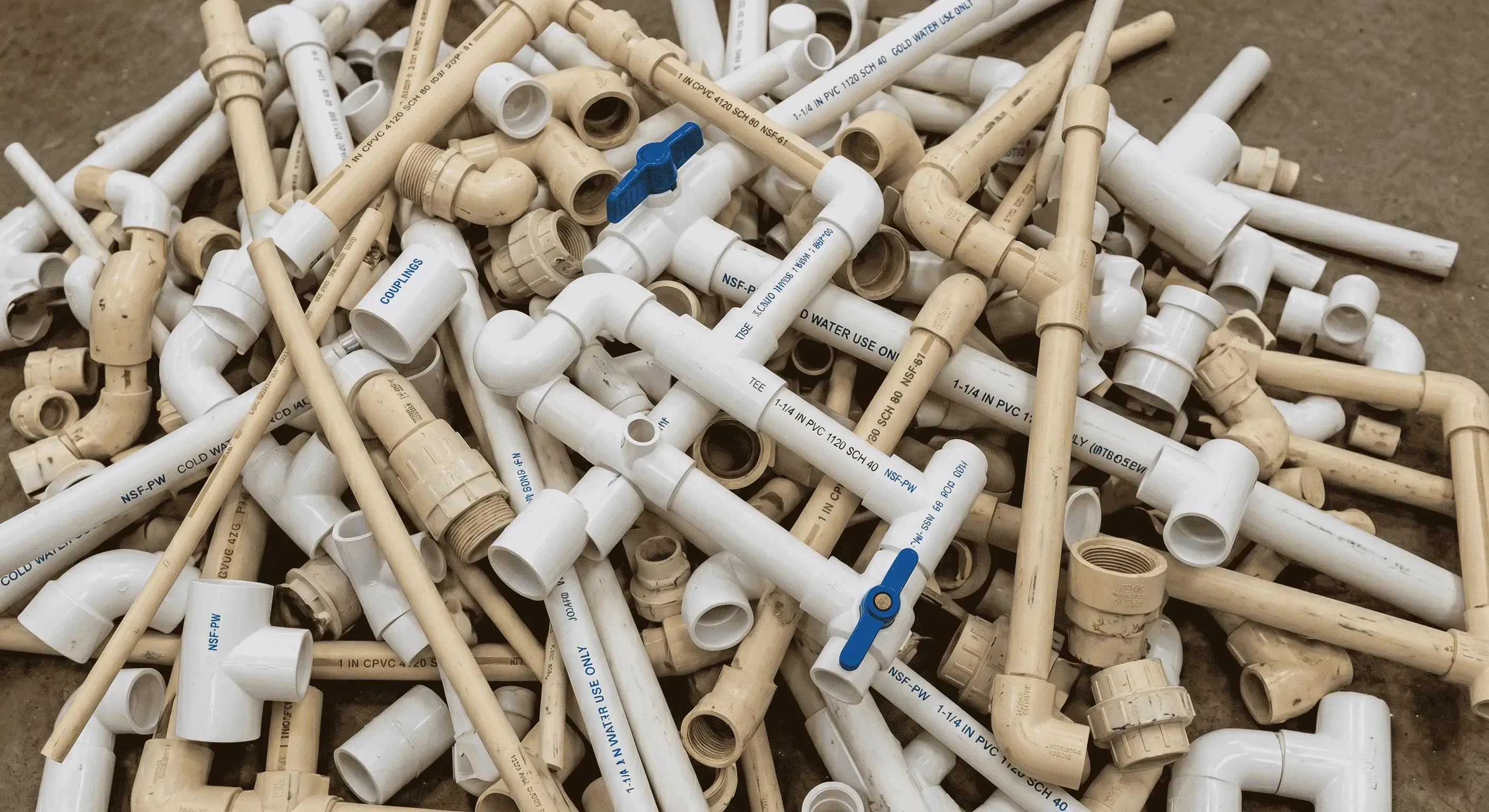
| Color | Bright White | Cream, Off-White, or Light Yellow |
| Cost | Very Cheap | Moderately Priced (More than PVC) |
| Sizing System | IPS (Iron Pipe Size - Thicker walls) | CTS (Copper Tube Size - Thinner walls) |
The Heat Test: Why the "C" Matters
The single biggest structural mistake a professional installer can make is running hot water supply linesthrough PVC. To understand why this happens, we have to look closely at the chemical architecture of the plastic itself.
PVC stands for Polyvinyl Chloride. In its standard formulation, this thermoplastic material tops out at a maximum operational threshold of 140°F (60°C).
Now, let's look at the actual reality of your home's thermodynamic footprint. Your domestic hot water is routinely set to store and push out water between 120°F and 140°F to prevent bacterial growth like Legionella.
If your water heater spikes, or if the thermostat fluctuates slightly upward, your hot water supply lines will match or exceed the absolute physical limits of standard PVC.
When subjected to persistent temperatures near its limit, PVC undergoes thermal degradation. The rigid plastic begins to soften, warp, sag, and eventually balloon until it bursts under pressure.
On the other side of the ring sits CPVC. The "C" stands for Chlorinated.
During the manufacturing process, standard polyvinyl chloride undergoes a specialized chlorination reaction. This structural modification introduces additional chlorine atoms onto the hydrocarbon backbone of the polymer.
This tiny chemical upgrade creates a massive physical shield, boosting the material's thermal properties significantly.
Because of this extra molecular protection, CPVC can withstand continuous operational temperatures all the way up to 200°F (93°C).
It handles boiling, pressurized water without breaking a sweat, making it the legally code-compliant and mechanically sound choice for the interior lines feeding your hot showers, bathroom vanities, and washing machines.
The Sizing Trap: They Do Not Mix
Do not buy an assorted bucket of both pipe types thinking you can seamlessly patch them together end-to-end when running a new plumbing run.
They do not talk to each other, and they do not share the same spatial dimensions.
Standard white PVC utilizes the IPS (Iron Pipe Size) framework. This means that a half-inch PVC pipe is designed to match the outer dimensions of traditional iron piping, prioritizing thick walls to resist external crush pressures when buried deep under soil.
Conversely, CPVC predominantly utilizes the CTS (Copper Tube Size) system.
CTS pipes are engineered to match the sizing profiles of copper tubing, allowing plumbers to easily swap out old copper networks for modern plastic infrastructure without completely redesigning the routing gaps through wall studs.
If you try to force them together, you will be left with an uneven gap that will fail completely under pressure.
If your project demands that you transition from a PVC line to a CPVC line, you must use specialized, threaded transition fittings or mechanical unions designed specifically to bridge the IPS-to-CTS gap.
Furthermore, you cannot mix their chemical bonding agents.
PVC solvent cement relies on a specific chemical formula to partially melt and weld PVC plastic together.
If you attempt to use standard PVC glue on a CPVC pipe network, the solvent will fail to properly dissolve the chlorinated material, resulting in a joint that looks sealed on the outside but will pop apart the moment your main water valve is turned back on.
Always match PVC glue with PVC, and CPVC glue with CPVC.
Mechanical Strength, Lifespan, and Structural Durability
When you are burying plumbing infrastructure inside finished walls behind expensive tile and heavy drywall, you need to know exactly how long these materials will endure.
Both PVC and CPVC are highly resilient against rust, corrosion, scaling, and microbiological buildup that corrode older galvanized iron and copper systems.
However, their mechanical behavior under environmental stressors differs.
PVC displays excellent structural rigidity and impact resistance at room temperature, making it ideal for large-diameter drain stacks that must stay perfectly aligned over long vertical drops.
However, when exposed to freezing external conditions, PVC becomes highly brittle and vulnerable to cracking if struck or if internal water begins to expand.
CPVC, owing to its chlorinated formulation, maintains better structural integrity across a broader thermal spectrum.
It retains flexibility under high temperatures and handles pressure inside enclosed residential spaces exceptionally well.
Under proper operational conditions—meaning keeping pressures within rated limits and avoiding chemical contamination—both PVC and CPVC systems boast a design lifespan exceeding 50 years.
The real differentiator in their lifespan isn't the plastic itself; it's the quality of the solvent and the execution during installation.
Chemical Compatibility and Drinking Water Safety
A major point of concern for any homeowner or builder is the chemical safety of the water pouring out of the kitchen tap.
This is an area where CPVC shines brightly for interior delivery.
CPVC is fully certified to meet stringent national drinking water standards (such as NSF/ANSI 61).
Because its molecular structure is highly stable and tightly bonded, it does not leach plastic chemicals, odors, or strange tastes into your potable water supply, even when exposed to highly chlorinated municipal water treatments.
Standard PVC is also safe for cold potable water distribution, but its application is heavily restricted by modern building codes for internal drinking lines.
PVC is more prone to degrading if it comes into contact with specific household chemicals, industrial solvents, or petroleum-based products.
For instance, you must never wrap PVC pipes in certain types of rubber insulation or allow them to come into contact with specific chemical plasticizers which can increase the risk of migrating into the pipe, causing it to crack or turn brittle over time.
CPVC exhibits higher chemical resistance to these compounding agents, though care must still be exercised to use approved accessory materials.
A few Insights
Let's look at the financial realities and finalize plan for your next trip to the plumbing supplier.
Follow the function, follow the temperature, and select the correct match:
Go with PVC if:
You are installing an outdoor backyard sprinkler system, fixing a kitchen sink drain basket trap, routing a main gutter downspout away from your foundation, or managing heavy waste drainage.
It is cost-effective, highly rigid, and perfect for moving unpressurized cold waste.
Go with CPVC if:
You are repairing or installing actual water supply distribution lines inside your bathroom, laundry room, or kitchen walls.
It costs more per linear foot, but it completely guarantees your hot water stays safely inside the pipe system.
Frequently Asked Questions (FAQ)
No! don't think about it as, PVC solvent is formulated for PVC, and CPVC sokvent is formulated for CPVC. The cement contains distinct active solvents and structural polymers to break down and weld chlorinated plastic.
Swapping them disrupts the chemical welding process, creating weak bonds that will eventually leak or burst under normal domestic water pressures.
The easiest indicator is color. Standard PVC pipes are bright and architectural white or occasionally a solid, dark blue.
CPVC pipes have an off-white, cream, or light yellowish-tan complexion.
Additionally, CPVC lines will almost always feature a continuous, thin yellow or red print strip running down the side of the pipe along with the explicit "CPVC" text stamped into the material.
The price premium of CPVC comes down to advanced chemical processing.
Chlorinating standard PVC requires additional manufacturing steps, specialized industrial equipment, and more exensive raw material to ensure structural stability during extrusion.
While this raises the material cost compared to basic PVC, CPVC remains significantly cheaper, faster, and easier to install than traditional copper pipes, making it a highly economical choice for pressurized hot water lines.
Untreated PVC and CPVC are fragile against Ultraviolet (UV) radiation.
Over prolonged exposure, UV rays break down the polymer chains, causing the plastic to discolor, become brittle, and lose its resistance.
If you must run PVC for outdoor irrigation or water features above ground, it should be fully painted with a high-quality, water-based latex paint to shield it from solar rays.
While CPVC has a tiny bit more structural flexibility than standard PVC, it is still fundamentally classified as a rigid plastic pipe system.
It cannot be bent around tight corners or snaked through walls like flexible PEX (cross-linked polyethylene) tubing.
To change directions with CPVC, you must explicitly cut the pipe and install dedicated 45-degree or 90-degree fittings.


